




The familiar label “vitamin B3” can hide an important distinction: niacin and niacinamide are related, but they aren’t identical ingredients. In the niacinamide vs niacin for skin comparison, niacinamide, also called nicotinamide, is the form commonly used in topical skincare; niacin is nicotinic acid and can cause flushing when taken at certain doses.
It’s easy to assume that two names for vitamin B3 mean the same thing for your skin. They don’t work identically, and the right choice depends on whether you’re considering a topical formula or an oral supplement, as well as your skin goals and tolerance.
This guide explains how niacin, niacinamide, and nicotinamide differ, what to consider when choosing a niacinamide concentration, and how niacinamide can be combined with ingredients such as hyaluronic acid or benzoyl peroxide. It also clarifies where topical skincare guidance ends and why supplements require a different kind of care.
Key Takeaways
- Learn why niacin, niacinamide, and nicotinamide are related names but not interchangeable choices for every skin-care goal.
- See how to select a niacinamide concentration that suits your skin and the concern you want to address.
- Understand which ingredients can complement niacinamide and how combining them may support a more considered routine.
- Separate topical skin-care use from oral supplement use, which involves different considerations.
- Find out when a niacinamide supplement such as Super Niacinamide may fit your wellness needs.
What Is Niacin (Vitamin B3)?
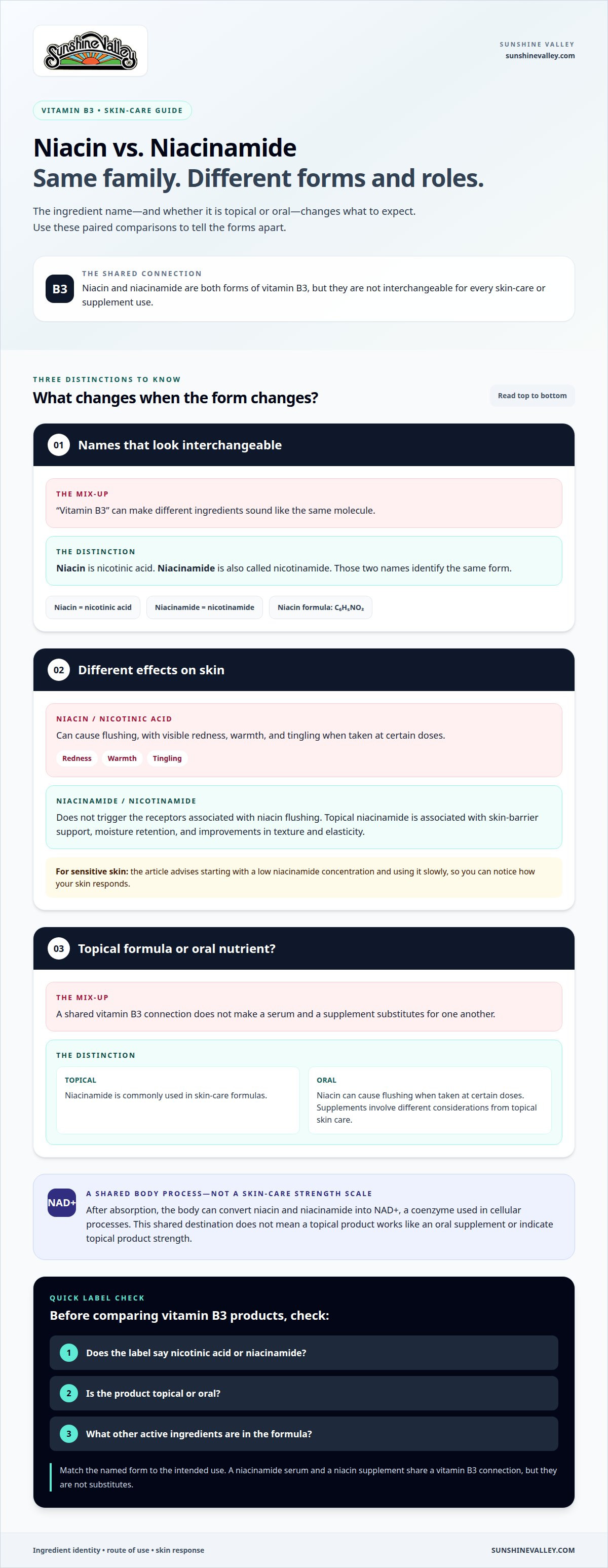
Niacin and niacinamide are both forms of vitamin B3, a nutrient involved in the body’s energy processes. Their shared vitamin family does not make them identical for skin or supplement use.
Forms of Vitamin B3
Niacinamide is a form of vitamin B3, alongside niacin, also called nicotinic acid. The distinction matters because the forms have different effects: niacin can cause flushing, while niacinamide is commonly used in skin-care formulas. Knowing which form a label names helps distinguish a topical product from an oral nutrient.
The body can also make niacinamide when it has excess niacin, or convert the amino acid tryptophan into niacinamide. These pathways explain why the terms are related, but they don’t mean a topical niacinamide product works like an oral niacin supplement.
Conversion to NAD+
After absorption, the body can convert niacin and niacinamide into NAD+, a coenzyme used in cellular processes. This shared destination explains why both compounds belong to vitamin B3, even though their names and effects differ. For readers comparing skin products, conversion to NAD+ describes a body process, not a measure of topical product strength.
The small intestine absorbs niacin and niacinamide before the body converts them to NAD+. Niacinamide absorption occurs through passive diffusion, while niacin absorption can involve sodium-dependent diffusion at low amounts or passive diffusion at high amounts. These different routes help explain how related forms can behave differently before contributing to the same coenzyme.
The Australian ONTRAC trial studied oral nicotinamide in high-risk participants. According to Australian ONTRAC trial investigators, participants received 500 mg of oral nicotinamide twice daily. Actinic keratosis incidence was 13% lower in the nicotinamide group than in the placebo group, according to Australian ONTRAC trial investigators. These findings concern oral use in a specific study group, not topical application.
Vitamin C may also appear alongside niacinamide in a skincare routine. Pairing them doesn’t turn niacinamide into niacin or change the body’s conversion to NAD+. Treat them as separate ingredients with distinct roles, and introduce a new formula gradually so you can identify which product may be linked to a skin reaction.
Multiple reports describe 1g daily of nicotinamide as well tolerated, with minimal or no adverse events reported. This summary does not mean every person will respond the same way, or that a skin-care product has the same tolerability. Individual skin response remains relevant when choosing a topical formula.
People with sensitive skin are advised to start with a low concentration of niacinamide and use it slowly. A cautious introduction can make it easier to notice whether a product agrees with your skin before making it a regular part of a routine. Keep the approach gradual rather than assuming that a vitamin B3 ingredient will suit everyone equally.
What is the Difference between Niacin and Niacinamide?
Niacin is nicotinic acid; niacinamide is its related amide form. Niacinamide is used topically for skin, while orally taken niacin can cause visible flushing.
Chemical and Molecular Differences
The key molecular distinction is the functional group: nicotinic acid has a carboxylic acid group, while niacinamide has an amide group. Niacin, specifically nicotinic acid, has the chemical formula C₆H₅NO₂. That structural change matters because the compounds can produce different effects, even though both belong to vitamin B3.
Think of these names as related chemical forms, not interchangeable labels for the same molecule. Their shared vitamin classification describes a nutritional relationship; it doesn’t mean a topical niacinamide product has the same purpose or effect on skin as niacin.
Nicotinic Acid, Nicotinamide, and Niacinamide
Nicotinic acid is the chemical name for niacin, while nicotinamide and niacinamide are two names for the same compound. On a label, “niacinamide” and “nicotinamide” therefore identify the same form, not two separate skincare ingredients.
This distinction helps when comparing topical formulas with supplement labels. For example, a product listing nicotinamide is identifying the niacinamide form; a product listing nicotinic acid is identifying niacin. Read the ingredient name itself rather than assuming that every vitamin B3 label describes an identical ingredient.
Different Effects on Skin
Niacin and niacinamide affect skin differently. Niacin can cause flushing, with redness, warmth, and tingling, while niacinamide doesn’t trigger the receptors associated with that response. Topical niacinamide is associated with skin-barrier support, moisture retention, and improvements in texture and elasticity.
This topical distinction also matters for people concerned about inflammation or uneven tone. Niacinamide is used in skincare formulas for these concerns, while niacin-related flushing is a different effect, not a skincare benefit. The ingredient’s form and route of use help set expectations.
Cellular activity provides context for the shared vitamin B3 family, but it doesn’t erase the compounds’ chemical differences. The body can use these related forms in processes involving NAD+, yet a topical application and an oral nutrient serve different roles. A skin-care label describes what’s applied to the surface; it doesn’t indicate that the formula works like an oral supplement.
For a practical comparison, check three details on the label: whether it says nicotinic acid or niacinamide, whether the product is topical or oral, and what other active ingredients appear in the formula. A niacinamide serum and a niacin supplement may share a vitamin B3 connection, but they aren’t substitutes for one another. Matching the named form to the intended use is the useful first step.
Niacin Vs Niacinamide Vs Nicotinamide: Which Is Best For Your Skin?
For topical skincare, niacinamide is the more relevant form; niacin is better known for causing flushing when taken orally. Nicotinamide is another name for niacinamide, so the label distinguishes it from nicotinic acid.
A Japanese trial gives one example of topical evidence. Study authors reported reduced sebum excretion after 2 to 4 weeks of daily use of 2% niacinamide among 100 Japanese participants. This finding concerns oil production, not every possible skin concern. It doesn’t establish that the same formula will address wrinkles, pigmentation, or other changes.
For signs associated with skin ageing, a topical trial examined 5% niacinamide in 50 women aged 40 to 60. After 12 weeks, the researchers found significant improvement in facial wrinkles. Niacinamide is also used in formulas targeting texture and elasticity. These findings describe specific study outcomes, not a guarantee that every product or routine will produce the same effects.
Brightening evidence focuses on pigmentation processes. In a keratinocyte and melanocyte coculture model, niacinamide reduced melanosome transfer by 35 to 68 percent. That result comes from cultured cells, so it differs from measuring visible changes in people. For dark spots, the formula’s concentration and the underlying cause of pigmentation matter when interpreting product claims.
Oral supplements aren’t a general-purpose substitute for topical skin care. In a study of people with a history of nonmelanoma skin cancer, skin cancer cases fell by 23% among 386 participants who took niacinamide twice daily for 12 months, according to Study authors. That result applies to the studied group and supplement use, not routine cosmetic skin goals.
Niacin supplements can cause flushing, with redness, warmth, or tingling. In the United States, this response typically occurs at nicotinic acid doses of 30-50 mg or more. High-dose niacinamide has different potential side effects; very high doses have been associated with liver effects, and long-term effects at very high doses aren’t fully understood. Consult a doctor before taking niacin or niacinamide supplements.
Topical niacinamide is generally considered gentle, but allergic reactions, itching, mild burning, or redness can occur. Consult a dermatologist about a persistent reaction, a changing spot, or a skin concern that needs diagnosis. People with a history of nonmelanoma skin cancer should distinguish the study’s oral supplement findings from topical cosmetic use.
Niacinamide concentrations and product selection
Choose a formula by matching its niacinamide concentration and format to your skincare goal. The labeled percentage, application directions, and full ingredient list can all help guide your choice.
Choosing Product Concentrations
For barrier support and hydration, a product with 2% niacinamide is one option for daily use. Concentrations between 2% and 5% are commonly used, while 4% to 5% formulas target concerns such as acne, hyperpigmentation, and fine lines. Most skin-care products contain 5% or less.
A higher percentage isn’t automatically a better match. Formulas with 10%, 15%, or 20% niacinamide may increase irritation, redness, and stinging. If your skin is sensitive, begin with a low concentration and introduce it gradually rather than starting with the strongest serum.
Niacinamide for Acne and Rosacea
For acne, concentration can help you compare a niacinamide product with other topical ingredients. One study found that topical 4% niacinamide was as effective as 1% clindamycin for acne treatment. That finding gives a specific comparison, but it doesn’t mean every 4% serum has the same formula or result.
Products marketed for rosacea may focus on redness and barrier support, but those claims don’t establish that niacinamide treats rosacea itself. Check whether a product’s stated purpose and ingredients suit your concern, and don’t assume persistent facial redness is acne without understanding its cause.
Why Products Use Niacinamide
Skincare formulas use niacinamide to support the skin barrier, help retain moisture, and address texture or uneven pigmentation. These roles explain why the ingredient appears in serums, moisturizers, and products for different skin concerns. Consider the full formula as well as the niacinamide percentage.
Application directions offer another useful comparison. Niacinamide may be used once or twice daily, and product guidance commonly places it after gentle cleansing. If you’re introducing a new formula, patch test first and wait 24 hours after applying it to your forearm before using it more broadly.
Price alone can’t tell you whether a niacinamide product suits your skin or contains a concentration you want. Compare the percentage, format, supporting ingredients, and directions instead. For example, someone focused on hydration may prefer a lower-concentration formula, while someone comparing acne products may consider the evidence for 4% niacinamide. A careful match is more useful than choosing the highest percentage or the most expensive serum.
Combining niacinamide with other ingredients
Niacinamide can be used alongside other active ingredients, but the best pairing depends on your concern. Evidence for specific combinations is more useful than assuming that adding more ingredients will always improve a formula.
Benzoyl peroxide for acne: One study suggests that 5% niacinamide combined with 2.5% benzoyl peroxide works better for acne than 2.5% benzoyl peroxide alone. The comparison matters because it evaluates the combination against the same benzoyl peroxide concentration without niacinamide. It doesn’t show that every formula or routine will behave identically, so consider the concentration and the product’s other ingredients.
Hyaluronic acid for hydration: Pairing niacinamide with hyaluronic acid may support a hydration-focused routine. A reported difference may appear by about 4 weeks, with more hydrated, smoother, and toned skin after 8 weeks. These time points help set expectations for the studied combination; they aren’t a reason to layer several new products at once. Introduce one change at a time so you can identify which ingredient suits your skin.
Barrier-supporting formulas: Skin-barrier lipids include ceramides and cholesterol. In cultured skin cells, nicotinamide increased ceramide biosynthesis by 4.1 to 5.5-fold over 6 days. This laboratory finding offers a reason niacinamide appears in barrier-focused products, but it does not measure the effect of a finished cream on a person’s skin. Look at the whole formula, including moisturizing ingredients, rather than judging it by one active alone.
Layering is a separate question from ingredient compatibility. A routine might include a niacinamide serum and a moisturizer containing hyaluronic acid; product texture and directions can guide which to apply first. Keep the routine simple as you add products. Introducing several new ingredients at once makes it harder to identify which one may cause irritation or redness.
Niacinamide’s role in cellular processes involving NAD+ shouldn’t be confused with the immediate skin effects of a topical combination. NAD+ participates in cellular energy processes, but pairing two topical ingredients doesn’t establish an energy benefit. For a clear comparison, match the combination to a defined goal, such as acne support with benzoyl peroxide or hydration with hyaluronic acid, then use the formula as directed.
For a niacinamide supplement option, explore Super Niacinamide.
Sunshine Valley: Super Mannitol
Sunshine Valley® Super Mannitol is a separate supplement, not a substitute for niacinamide skincare. For readers considering niacinamide as a supplement, Sunshine Valley® also offers Super Niacinamide. Keep the distinction clear: concentration guidance in this article concerns topical products, while supplements are oral nutrient products with a different role.
Choose based on the question you’re answering. A topical formula is relevant to a skincare routine; Sunshine Valley® Super Niacinamide is the related product to explore when considering niacinamide in supplement form. Sunshine Valley® also offers Super Inositol and Super Lactose.
For more information, visit sunshinevalley.com.
Choose Your Next Step With Confidence
Let the product’s purpose guide your next decision. For a topical routine, consider how the formula fits your skin’s needs and the other ingredients you use. An oral supplement is a separate wellness choice, not a replacement for skincare. The niacinamide vs niacin for skin comparison is most useful when you keep these uses distinct.
When considering niacinamide vs niacin for skin, focus on whether you’re choosing a topical formula or an oral supplement. If you’re exploring Sunshine Valley® supplements, the range includes Super Mannitol, Super Inositol, and Super Lactose. Review the product information and decide whether one suits what you’re looking for.
Contact Sunshine Valley today to take the next step. A thoughtful approach can help you move forward with confidence.
Frequently Asked Questions
Are They Truly the Same?
No. Niacin and niacinamide are different chemical forms of vitamin B3, while nicotinamide is another name for niacinamide. On an ingredient label, “nicotinamide” and “niacinamide” identify the same compound; “niacin” usually refers to nicotinic acid. Checking the precise name can help you avoid confusing a topical skincare ingredient with an oral supplement.
Both Are Vitamin B3, So What Is the Difference?
They belong to the same vitamin family but differ in chemical structure and effects. Niacin is nicotinic acid, whereas niacinamide is its amide form. That difference matters in practice: niacin can cause flushing, while niacinamide is commonly used in topical formulas. The shared vitamin B3 label describes their relationship, not identical uses or responses.
Can You Take Niacin and Niacinamide Together?
Ask a doctor before combining niacin and niacinamide supplements. Both contribute to vitamin B3 intake, and supplement products can contain different forms and amounts. Review each product’s ingredient label and serving directions before discussing the combination. Don’t treat an oral supplement plan as equivalent to applying a niacinamide serum, since route and intended use differ.
Does Niacinamide Help With Acne?
Topical niacinamide may be useful in acne-focused skincare. One study found that topical 4% niacinamide was as effective as 1% clindamycin for treating acne. That comparison can help you assess an ingredient label, but it doesn’t mean every niacinamide product has the same formula. Consider the full product and whether its directions fit your routine.
What Is the Function of Niacinamide?
Niacinamide has roles as both a nutrient and a topical skincare ingredient. In the body, it can be converted to NAD+, a coenzyme used in cellular processes. In skincare, it appears in formulas intended to support the skin barrier, moisture retention, texture, and elasticity. These are different contexts, so don’t confuse a topical product with an oral supplement.
What Is the Difference Between Niacinamide and Niacin?
Niacin is nicotinic acid; niacinamide is a related form of vitamin B3, also called nicotinamide. The distinction is useful when comparing a skin product with a supplement: niacinamide is commonly used topically, while oral niacin is associated with flushing. Read the active ingredient name rather than relying only on broad wording such as “vitamin B3.”
Which Form of Vitamin B3 Is Better for Acne, Redness, or Hyperpigmentation?
For topical skincare, niacinamide is the more relevant form to consider. Research includes a topical acne comparison, and niacinamide is used in formulas for uneven pigmentation and redness. Niacin can cause flushing, so it isn’t a substitute for a topical product targeting those concerns. Match the product’s stated use and ingredients to your skincare goal.
Can Topical Niacinamide Cause Skin Flushing Like Niacin?
Topical niacinamide doesn’t trigger the receptors associated with niacin flushing, which can cause warmth, redness, and tingling. However, topical products can rarely cause an allergic reaction, itching, mild burning, or redness. If a product causes discomfort, stop applying it and consider its ingredient list when deciding what to use next.


Leave a comment
This site is protected by hCaptcha and the hCaptcha Privacy Policy and Terms of Service apply.